
Musings
I love the process of writing. With just a single thought, idea, or question, one can explore a single topic and turn it into an expression of opinion, suggestion, or ideation.
Click to expand each essay
-
Socially responsible design being singled out as an area of study.
Call it what you will, social awareness, design for good, or ethnographic design why must we separate what should be practiced every day? Bottom-up design practices should be the norm, replacing the antiquated practices of yesteryear. Technically, at least from this author’s perspective, socially responsible design has been watered down, masked as being design with a socially conscious message. But it is not, nor is it a practice that is new.
Ideas come in waves are acted upon for commercial gain and then left in ruins for the newest trend. Not too many years ago everyone was going green. The green movement spanned industries until green became too expensive to sustain itself through an economic downturn. The blue-collar, middle-class American no longer could afford green products. The green movement became associated with the hipster/liberal crowd thus ostracizing a large portion of consumers. Green was no longer seen as a positive element for change, rather a push for change from a group who most could not relate.
Imagine, however, if designers, manufacturers, companies, retailers, etc. never leveraged the sustainability of new products. Instead, new sustainable products slowly replaced the old ones on the shelf. Remove all the marketing, messages, and design that accompanied greener products and take away the consumer’s opportunity to choose between good and bad. The only option offered is good, clean, and green. By ignoring the marketability of sustainable products and focusing on changing what and how we create products, we could have enacted more social change resulting in an abundance of green products on the shelves today.
Socially responsible design practices must be considered no matter the situation. Whether exploring a product’s market through big budget ethnographic research trips or designing for a low budget print run, the way we work as a creative industry must change. Can design change the world? No, but by changing the way we work, we can certainly be a measure of influence to others.
-
Social media has become a stomping ground for those who believe that the United States should provide its citizens free higher education. That the increased cost of universities and the subsequent loans they must acquire to attend these schools is a cost that is too much to bear. They point to systems all across the globe as examples where tuition is no longer required. However, it seems that they have forgotten that the pursuit of a higher education is a choice. They do not have to attend and their argument that one must have a college degree to be successful is not true. Success is not something you are given, rather it is something you must earn, with or without a piece of paper.
The stories of college dropouts Bill Gates and Steve Jobs and their ability to revolutionize their respected industries are perfect examples. While they did not thrive in a traditional educational setting, they did surround themselves with like minded individuals and bet everyone’s future on their success or failure. Both Gates and Jobs are not unique. They do not hold the secret to finding success through independent learning. What made them unique was their fortitude to succeed.
As an educator I applaud those who seek a higher education. I believe the knowledge and experiences gained while in college prove to be invaluable later in life. However, I do not believe that these experiences can come without a cost.
Can a system be put in place where individuals can earn a tuition-free education? Yes, but we must not rely on the federal government to subsidize the costs necessary to run effective higher education institutions. In order for a tuition-free education to exist expect to see new taxes, higher fees, higher room and board, higher book costs, higher cost of campus meals, parking, bus fares, just to name a few. In addition to the elimination of low cost or previously free services, look for universities to implement stricter entry and enrollment qualifications.
At the end of the day, maintaining a tuition-free higher education system will end up costing far more than retaining the existing tuition-based model.
How can we then offer individuals incentives to pursue higher education?
Here is my idea: Scholarship for All.
Embracing the idea that hard work and stewardship should be rewarded, Scholarship for All sets out to provide a tuition-free environment for those individuals who meet and fulfill a specific set of requirements to earn tuition forgiveness.
Requirements:
Only four years of tuition will be paid.
Public, state-funded universities only.
Students must meet the entry requirements of the school they are applying.
Students must maintain a 3.2 GPA (grade point average) throughout their college career.
Students must commit to four years of public service commencing immediately after graduation. A list of organizations and services will be selected by federal and state governments.
Failure to maintain the required GPA will result in the immediate disqualification from the program.
Failure to provide service will result in the immediate termination of tuition forgiveness and the individual will be required to pay the full tuition price plus interest.
Failure to finish the four year program will result in the termination of tuition forgiveness, disqualification from the program with no opportunity to return.
Previous public service cannot be used retroactively to fulfill the post-graduation requirements.
Students will be required to sign a legal contract agreeing to all terms.
Veterans serving at least four years prior to attending a university will not be required to provide any additional service post graduation. If military service amounts to less than four years, that individual will need to complete the remaining years of public service required post graduation.
-
Experience is an interesting thing; whether it's lessons learned from practice or knowledge gained from conversations, it is the small experiences we encounter when working with a variety of individuals, clients, and companies that end up affecting us the most.
As a junior designer in the sluggish economy that followed 9/11, I spent a good portion of time around the entire office. Whether upstairs with my art directors and senior designers perfecting production techniques, or downstairs chatting with the owner, bookkeeping, or marketing, I was a sponge trying to soak up as much information as I could. I learned a lot during my one year at this design firm, but little did I know that one small conversation with the marketing director would change how I perceived the details of design.
The discussion in question could have been lifted directly from a Seinfeld episode as we were talking about the mundane; a rather uneventful talk about coffee. I learned that he was a former owner and operator of a coffee shop and while we talked he took a sip of his coffee. A slow and steady drip preceded down the side of his cup. He set the coffee down and repositioned the lid explaining to me that few people in the coffee business knew that if the lid was not positioned correctly—anywhere but directly over the seam of the cup—neither it nor the cup would function properly. Useless knowledge I assumed, interesting, but useless.
Fourteen years later as I buy my morning coffee, prior to putting on the lid, I find myself checking to see where the seam of the cup falls. Because, after all, our mundane and brief conversation had inadvertently changed my behavior just as the constant perfecting of my production skills had changed my design process. A conversation about coffee, not design, had changed my habits and perception of how the smallest of details can make or break a design.
-
When I was in school we had two computer labs, the one we could touch and the one we could not. The latter belonged to the animation students and lived in a closet-sized room down the hall from our lab. The designers’ lab was larger, brighter, and for its day, pretty well equipped. We had twenty-five or so macs, some sort of wax-based printer, and a black and white laser. Classes were not held in the lab, but in a room filled with drafting tables. Our work was done outside of class, or if you were lucky, on your computer at home. An additional luxury would have been a scanner or the newest technology, an inkjet printer.
There was a reason that most of my designs could be constructed with 8.5 x 11 inch sheets of paper. As students we had to be inventive not only with our materials, but more importantly with the use of our time. There were no print centers that we could access to print things out fifteen minutes before class. Each piece created was a work of art; a one-off exclusive design.
Even as I entered graduate school, a decade later, I again was faced with the challenge of producing exquisite works with limited availability to technology. The professors and the school demanded perfection from our work, pushed us to produce artifacts that were as close to perfection as possible. It was up to the student to determine the use of materials, locate the services, and work with those necessary to have the design produced while meeting those high expectations.
In retrospect, the often negatively discussed lack of printing technology available to the student, makes perfect sense. Make the student plan for production time by taking away the main resource needed for quick, and often poor, production while also demanding perfect work.
Both school's pedagogy, even when experienced ten years apart, taught their students the importance of innovative thinking when dealing with technology and design. They pushed us to think ahead, think about the next steps while we were still on step one. We were encouraged to be creative not only with our work, but with our time. As students we knew that we should not expect anything to be given to us, but that we must work to earn what we got. And even then we would be pushed harder to achieve the greatness that we were expected to achieve.
For a generation of design students and many more to come, having technology at their fingertips will become design’s greatest burden up to educators to solve.
As a professor myself, I feel that to properly educate these generations, we must remove them from the technology they have become accustomed. Make them feel uncomfortable. Put them in a class with no computers, but a syllabus full of work to complete. Encourage discussion and thought, controversy and clarity, doubt and inquiry. Take away the printing labs and the free printing. Force students to look beyond the traditional — the easy route — to include other methods. Let them learn from trial and error, cuts and bruises, mistakes and cost; let them learn from themselves.
I am not suggesting that the educator be removed from the equation, but merely rethink the use of technology in the classroom. What I did not mention is that although my graduate classes focused on discussion and thought, we often sat in a room filled with computers. We read from photocopies of books and articles our professors would find. After leaving class, research was not done solely on the computer but in the library. Technology was a means to an end, never the starting point.
-
* Please note that the following was written prior to the current NFL rules that have since applied similar logic.
It’s time for the NFL to establish a hit zone.
Every year the NFLs competition committee meets to try and make the game safer by defining new rules to protect its players. Unfortunately the final written rule is so complex that even the best interpretation is debated both on and off the field.
Take a moment and read Rule 12 Player Conduct, Section 2 Personal Fouls, Articles 8 & 9.
Welcome back. If you managed to read the whole PDF, I applaud you. If you are even more confused than when you started, don't worry I think the NFL as a whole is lost at this point too. So what is a legal hit? When is a player deemed defenseless? What constitutes a legal hit to the head? The failure of the interpretation of the rule is the failure of the author(s) responsible for its wording. A failure that could easily be cleared up with a simple graphic depicting what is an acceptable hit on all players just as the strike zone in baseball accommodates an entire league of players.
Major League Baseball (MLB) has just as much wording within their official rulebook as does the NFL, however the strike zone can be easily described as the area on a player between the numbers and knees. The enforcement of the zone is then left up to umpires officiating the game. For a player to argue a call is means for ejection. Simple. So simple that a graphic is all that is needed to understand the rule.
Now let’s apply the same theory to the National Football League.
Any area above the chin strap would be considered an illegal hit.
Any hit from the below the chin to a player’s mid thigh would be a clean, legal hit.
Hits below mid thigh must be made with the hands or arms only. Special consideration would need to be given to kickers and quarterbacks.
Most importantly these rules can be represented in a simple and clear graphic that players, coaches, fans and referees could easily understand. Final rulings would be up to the referees and as in the game of baseball further penalties could be enforced if a ruling is argued by the player(s) or coach(es).
-
Why is it that when conflict arises students first gossip, complain and then settle and do very little or nothing at all? Has the revolutionary spirit been lost? This trend could be compared to the annual gripe over the government’s actions by someone who never votes. But in most conflicts those who are affected the most do not have a voice … or do they?
As designers, depending on your school of thought, we are asked to beautify, through concept, a particular problem or challenge using the “principles of design”. Unfortunately there are not enough schools, or possibly professors, which embrace the need for students to learn how to communicate a specific message through their designs. Yes, students are asked to target a certain demographic with visuals, typography, and color, but do they have an understanding of why, how, or what is being communicated by the design applied to the final artifact?
I think not.
Young designers have come to understand that professors and society do not react well to ugly. Therefore, as students, designers learn to create beautiful design and meander their way through the conceptual explanation of their work.
What happens when the problem is an ugly truth, a crisis or a conflict? It certainly would not be responsible to glamorize such events. Do young designers and students have the necessary understanding to communicate beyond socially acceptable issues? I do not think so; which is unfortunate because it is often the ugly truth that needs the most exposure and it is the designer who has the essential skills to properly communicate to a much greater degree than any other single individual in our society today.
So the next time something happens that gets you upset, stop and design. Help deliver a message to the community being affected. A well thought out design with the specific aim of informing, will do far more than one overly emotional rant to those who created and are familiar with the problem.
Start a revolution through design. It can be done.
The designer has the power to change everything through design. So rise up and act. Never just settle and beautify.
Through the Eyes of Another
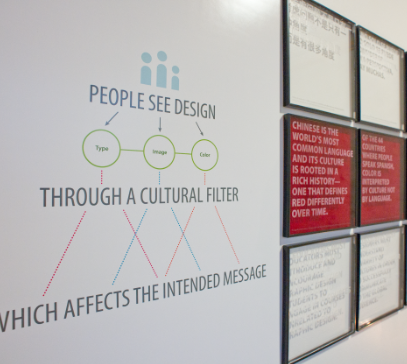
In my graduate thesis, I examined the need for a shift in the pedagogy of academic institutions that offer programs in graphic design. The necessity of this change is driven by the exposure of the graphic design industry to a global marketplace—one in which cultural ignorance will only embarrass the designer and the clients they represent. In order to prepare a future generation of graphic designers, it is up to educators to introduce and encourage students to view projects from multiple perspectives and engage in courses unrelated to graphic design. Until institutions overhaul the graphic design curriculum to include a course track that incorporates cultural studies, professors must provide their students the opportunity to address multicultural audiences through various projects. The extensive knowledge a graphic design student will absorb from such practices offers multiple benefits, including better preparation to enter into the graphic design industry.